
Night is the Mother of Day.
Sleep is one of our most fundamental needs. So isn’t it strange that 40 % of people say they have problems sleeping? You have to wonder what nature was thinking...1
To be honest though, nature probably wasn’t expecting fluorescent tubes, mobile phones, coffee, and nine-to-five jobs. And if you think about it, it’s actually kind of amazing that most of us still manage to sleep fairly well, even if our modern lives do often derail our natural sleep cycle.
Sleep is a means. Not an end. It’s a process that allows the body to repair itself, to tidy up, and to clean up.2 And the more you know about sleep, particularly your own, the greater the chance that sleep will come when it’s supposed to.
AGB-Pharma’s goal is better sleep health for everyone. Not for the sake of the night. But for the sake of your day.

What is sleep and why do we sleep?
Sleep is something we have in common with almost every animal species on the planet. But all those different species sleep differently. Some, like us humans, have a single extended sleep period, while other sleep in short spurts, now and then. Elephants only sleep for two hours out of every 24, while some species of bats sleep for up to 20 hours a day.3
Why we sleep is still something of a scientific mystery. But we’re learning more and more about how we sleep and what happens when we sleep (or don’t sleep!).
It might feel like we’re doing nothing when we sleep, but the truth of the matter is that our bodies are very active when we sleep. As soon as we fall asleep, our blood pressure, pulse rate, body temperature, and respiratory rate all fall. Our muscles relax and our brain activity changes. Impressions and memories are processed, and new cells replace old ones. Communication within the cells that control the nervous system, the hormonal system, and the immune system increases.2
The sleep cycle
Our sleep is divided into sleep cycles, and we usually go through five sleep cycles per night. Every sleep cycle has four phases:4
1. Light sleep
1–5 minutes. You are only just asleep and can wake easily.2,4
2. Deeper sleep
10–60 minutes. Deeper relaxation and sleep.4
3. Deep non-REM sleep
20–40 minutes. The deepest non-dreaming sleep. This is when you find it hardest to wake up. This phase is thought to be important in terms of recovery for both your body and your brain.4
4. Dream sleep: REM (Rapid Eye Movement) sleep
10-60 minutes. Your brain’s activity increases again, and you dream. The percentage of dream sleep increases for each cycle. Dream sleep is thought to be particularly important to our emotional well-being.4
Why do we want to sleep?
Our bodies regulate our sleep in two ways – through sleep pressure and our circadian body clock.4
Sleep pressure is thought to be controlled by the neurotransmitter, adenosine, which increases in concentration in our bodies when we are awake. Caffeine, which is present in coffee amongst other things, reduces the effects of adenosine.4
Our body clock regulates WHEN we sleep and is controlled by the switches between daylight and darkness and regulated by the sleep hormones.4
Why do we want to sleep?
Our bodies regulate our sleep in two ways – through sleep pressure and our circadian body clock.4
Sleep pressure is thought to be controlled by the neurotransmitter, adenosine, which increases in concentration in our bodies when we are awake. Caffeine, which is present in coffee amongst other things, reduces the effects of adenosine.4
Our body clock regulates WHEN we sleep and is controlled by the switches between daylight and darkness and regulated by the sleep hormones.4
The internal body clock
The body’s own sleep hormone is, in evolutionary terms, very old – over 3 billion years. It plays many different roles in the body, not least in our internal body clock.5
Our body clock tells us when to sleep. And, like the majority of mammals, this is at night when it’s dark.3
Our body clock is controlled by light and darkness. Our eyes are constantly sending signals to the hypothalamus in the brain and when it’s light, the hypothalamus in turn sends signals that inhibit the production of sleep hormone. But when it gets dark, these signals are turned off and our body begins to secrete sleep hormones – and our body clock tells us it’s time to go to bed.6
Sometimes, our body clock can go wrong and we find it hard to sleep and wake at the right times. There can be many reasons why this happens, not least because in our modern society, there is plenty of light – even at night – and a whole host of other things that distract us from our body’s natural sleep signals.7
When you aren’t getting enough sleep to function normally during the day, this is what’s usually known as a “sleep disturbance.”
Sleep disturbances – when your body clock goes wrong
Around 4 in every 10 people say they find it hard to fall asleep. The problems seem to increase in middle age, and older people are more likely to say they have problems sleeping than younger ones. Women also have more sleep problems than men. Sleep problems are, in other words, pretty common. But they are also individual and manifest in different ways.1
There are five questions you can ask yourself to assess your general sleep health:2
1. Do you usually sleep for between 6 and 9 hours a night?
2. Do you usually sleep at night and are you usually awake during the day?
3. Do you sleep for the majority of the time you spend in bed?
4. Do you usually feel alert and awake during the day?
5. Are you, generally speaking, happy with your sleep?
If you can answer yes to all five questions, your sleep health is, in all probability, good.2

Different types of sleep disturbance
Good habits to keep your body clock working
Set routines
Try and go to bed at more or less the same time every day – including at weekends.2
Caffeine and alcohol
If you’re experiencing sleep difficulties, you should reduce your caffeine intake.8 Caffeine, which is present in coffee, tea, dark chocolate, and some soft drinks, amongst other things, competes with adenosine – a substance secreted by your body’s cells during the day, and which makes you feel tired. It takes 3-7 hours for half of your caffeine intake to be broken down by your body, which means that the amount of coffee you’ve drunk during the day affects the amount of caffeine in your body when it’s time to sleep.16
Alcohol, which disrupts every phase of your sleep (apart from actually falling asleep) can cause disturbed sleep, meaning that you wake more frequently during the night, and disrupt the vital recovery of your body and brain while you’re asleep. Snoring and sleep apnea (pauses in breathing while asleep) are worsened by alcohol.17
Food
Eat early in the evening so you’re not too full when you go to bed – but not so early that you’re hungry, which can make it difficult to fall asleep.8
Reduce screen brightness
The light from mobile phones, computers, and tablet screens often mimics daylight and can consequently affect production of sleep hormone in the brain. Leave the screens outside your bedroom and try not to look at them in the hour before you go to bed.8
Cool and dark
A cool, silent, and dark bedroom makes sleeping easier. Invest in proper blackout curtains and use thinner covers during the warmer times of the year.8
Relax
Get into the habit of chilling out at dusk, as our ancestors did. Turn the lights down low, and turn off all screens one hour before you go to bed. Air the bedroom so it’s cool. A bath or shower can help lower your body temperature and make it easier to fall asleep.8
No late naps
Avoid taking naps after 3 o’clock in the afternoon. Short naps can help compensate for lost night-time sleep, but if you sleep too long, it’ll actually be harder to fall asleep at night.8
Movement
Keep moving during the day and don’t stay sedentary for extended periods of time.8
Daylight
Your brain's production of sleep hormone is controlled by daylight. Making sure you get a few doses of natural daylight every day helps oil the wheels of your body’s own body clock, so it doesn’t break down.18

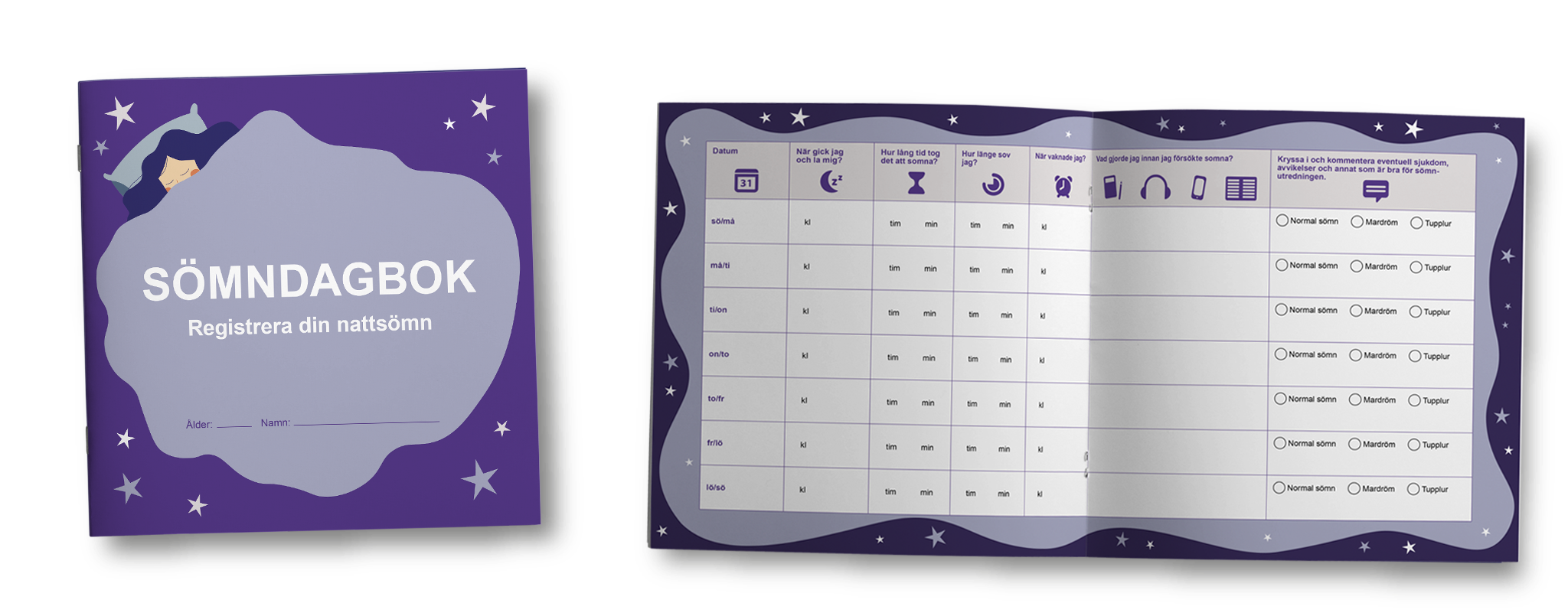
Sleep Diary:
How well do you sleep? Honestly?
If you feel that you or someone you’re close to has sleep problems that are affecting them when they’re awake, it may be a good idea to talk to a doctor.
But it can be difficult to estimate how much and how well you’re sleeping. Try keeping a sleep diary in which you make a note every day of how long you’ve slept, when you fell asleep, and how well or poorly you think you slept.
Your sleep diary can act as useful evidence and help any health care professional you talk to make a diagnosis and, potentially, prescribe medication.
1) Folkhälsomyndigheten (2023) Hur vanligt är sömnbesvär? [2024-01-10]
2) 1177.se (2023) Sömnen är viktig för hälsan [2024-01-10]
3) Sleep Foundation (2023) How Do Animals Sleep? [2024-01-10]
4) Sleep Foundation (2023) How Sleep Works: Understanding the Science of Sleep [2024-01-10]
5) Manchester LC, Coto-Montes A, Boga JA, Andersen LP, Zhou Z, Galano A, Vriend J, Tan DX, Reiter RJ. “Melatonin: an ancient molecule that makes oxygen metabolically tolerable. J Pineal Res. 2015 Nov;59(4):403-19. doi: 10.1111/jpi.12267. Epub 2015 Sep 11. PMID: 26272235. https://pubmed.ncbi.nlm.nih.gov/26272235/
6) Vetenskap & hälsa (2011) Den biologiska klockan [2024-01-10]
7) Karolinska Institutet (2023) Därför ska vi lyssna på kroppens rytm [2024-01-10]
8) 1177.se (2023) Sömnsvårigheter [2024-01-10]
9) Karolinska Institutet (2024) Nyfiken på sömnbrist: När John Blund vägrar dyka upp [2024-01-10]
10) Mayo Clinic (2022) Jet lag disorder [2024-01-10]
11) Netdoktor Pro (2023) Försenad sömnfas [2024-01-10]
12) Läkartidningen (2006) Försenad sömnfas [2024-01-10]
13) Internetpsykiatri (2023) Vad är insomni? [2024-01-10]
14) Janusinfo (2022) Beteenderåd vid insomni [2024-01-10]
15) Läkemedelsverket (2015) Sömnstörningar hos barn - Bakgrundsdokumentation s.49-51 [2024-01-10]
16) Karolinska Institutet (2024) Nyfiken på kaffe [2024-01-10]
17) Systembolaget (2023) Sussa sött utan alkohol [2024-01-10]
18) Läkartidningen (2019) Blått ljus ger oss vita nätter [2024-01-10]
SE-MEL-AGB 0102 12/2024
© 2024 AGB-Pharma AB. Last updated 12/2024